
Why LEGO®, STEM Toys, and Tinkering Matter More Than Ever
A thoughtful exploration of why LEGO®, STEM toys, and hands-on tinkering play a vital role in shaping curious, resilient, and creative thinkers—showing how meaningful, screen-free play helps children build lifelong problem-solving habits, not just toys.
Why LEGO® , STEM Toys, and Tinkering Matter More Than Ever
When we look at the lives of history’s greatest thinkers, creators, and innovators, a surprising pattern emerges: many of them didn’t begin their journeys with textbooks or screens—but with toys.
Not flashy toys.
Not noisy toys.
But tools for tinkering.
Simple blocks. Gears. Circuits. Mechanical parts. Objects that invited curiosity rather than instructions.
“Play is the highest form of research.”
— Albert Einstein
Long before Einstein reshaped physics, he was fascinated by a simple magnetic compass his father gave him as a child. That quiet moment of curiosity—Why does it move? What’s pulling it?—sparked a lifelong love for understanding how the world works.
This is the hidden power of LEGO®, STEM toys, and meaningful play.
Play That Builds the Brain (Not Just Entertainment)
High-quality STEM toys like LEGO®, engineering kits, and problem-solving games do something screens can’t:
They make children active creators, not passive consumers.
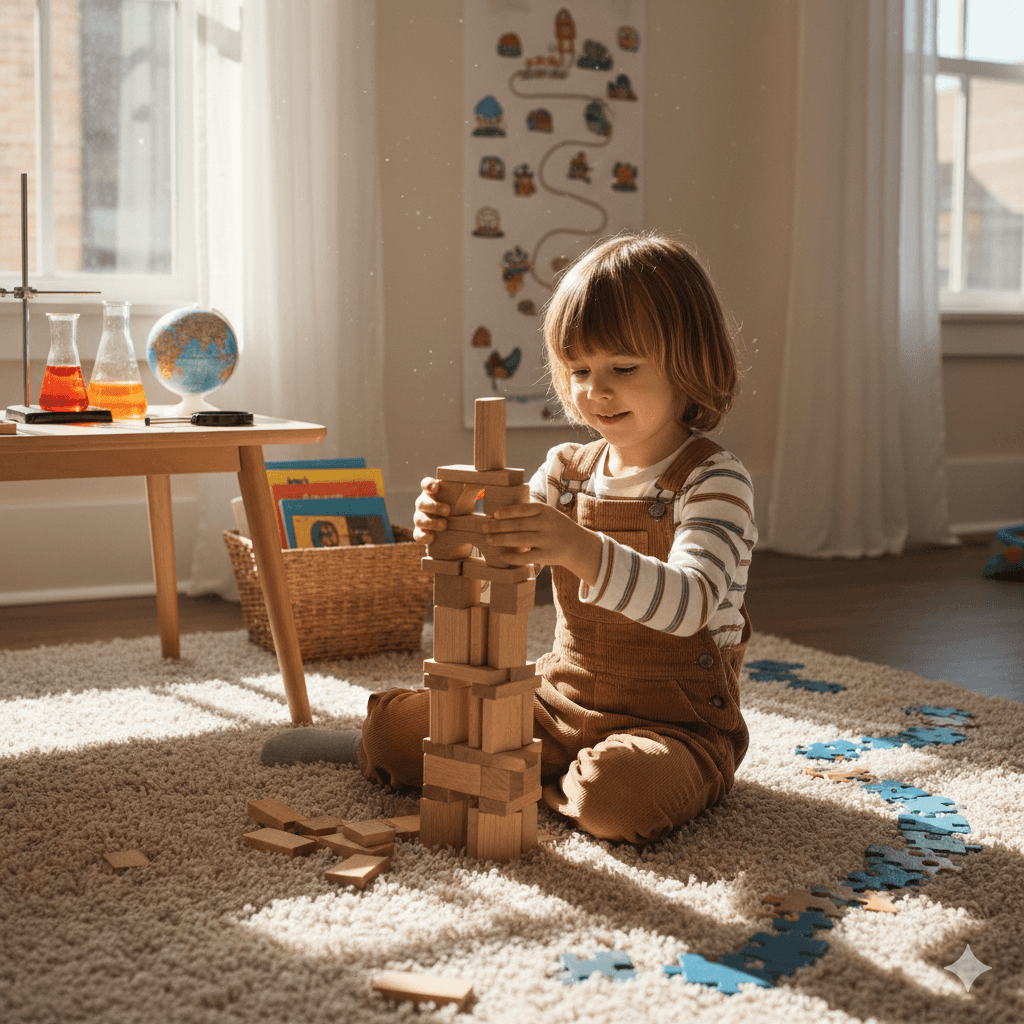
When a child builds with LEGO® / STEM kits or assembles a simple mechanism, they are unconsciously practicing:
Spatial reasoning
Logical thinking
Cause and effect
Patience and focus
Resilience through trial and error
There is no “skip level” button.
No instant gratification.
Only thinking, testing, adjusting—and trying again.
“The important thing is not to stop questioning.”
— Albert Einstein
That mindset—questioning, experimenting, failing safely—is exactly what STEM toys cultivate.
LEGO® / STEM kits: More Than Just Bricks
LEGO® / STEM kits is often underestimated because it looks simple. But that simplicity is precisely why it’s powerful.
With the same set of bricks, one child builds a bridge.
Another builds a robot.
Another builds something that collapses—and learns why.
LEGO® / STEM kits develops what educators call constructive play—play where children actively build mental models of the world.
Research consistently shows that children who engage in constructive and STEM-based play demonstrate stronger skills in:
Early mathematics
Engineering concepts
Creative problem-solving
Long-term attention span
It’s no coincidence that LEGO® / STEM kits is widely used in classrooms, robotics labs, and even adult design studios today.
The Childhoods of Great Innovators
Many of the world’s most influential minds grew up surrounded by tools for tinkering.
🔧 Elon Musk
Before founding Tesla or SpaceX, Musk spent his childhood dismantling electronics and building models. His curiosity wasn’t structured—it was exploratory.
🧠 Steve Jobs
Jobs credited his creativity to playful experimentation, calligraphy classes, and hands-on learning—experiences that had no immediate “purpose” at the time but shaped his ability to connect ideas later.
🧪 Marie Curie
As a child, Curie was deeply fascinated by experiments and problem-solving, encouraged to explore rather than memorise. That early freedom laid the foundation for groundbreaking scientific discovery.
What they shared wasn’t privilege—it was permission to explore.
Why Quality Matters in STEM Toys
Not all toys are equal.
High-quality STEM toys are designed to:
Encourage open-ended play (no single “right” answer)
Grow with the child across age stages
Prioritise thinking over flashing lights or sounds
Reward effort, not speed
Cheap, gimmicky toys often do the opposite:
They entertain briefly—but don’t invite deep engagement.
A well-designed LEGO® set or STEM kit can be returned to again and again, each time unlocking new ideas.
“Tell me and I forget. Teach me and I may remember. Involve me and I learn.”
— Benjamin Franklin
Screen-Free Play in a Screen-Heavy World
Today’s children are growing up in a world of instant answers and constant stimulation. While technology has its place, over-reliance on screens can reduce opportunities for deep focus and creative thinking.
STEM toys offer a powerful counterbalance:
No notifications
No algorithms
No endless scrolling
Just hands, mind, and imagination working together.
This kind of play doesn’t shout for attention—it quietly builds capability.
Building Habits That Last a Lifetime
The real value of LEGO® and STEM toys isn’t about creating future engineers (though many will). It’s about shaping how children think:
Can I figure this out?
What happens if I try again?
What else could this become?
These are life skills—useful in any field, from art to entrepreneurship.
At TBH, we believe the toys children grow up with shape the habits they carry forward. That’s why we prioritise thoughtfully curated books and high-quality STEM toys—the kind that encourage curiosity, confidence, and independent thinking.
Because the greatest minds didn’t grow up glued to screens.
They grew up building, breaking, and rebuilding ideas—one small piece at a time.